Budget allocation driven by incrementality, not last-click
We model each channel's true incremental impact with Google Meridian or Meta Robyn and turn the curves into practical budget reallocation scenarios. Project-based, no annual software license.
Every platform claims the conversion is theirs. Marketing mix modeling answers the question digital attribution can't: how much each channel actually adds, and what happens to results when the budget moves.
Last-click is lying to you
Click-based attribution sees the end of the journey and ignores the rest. Upper-funnel channels look expensive, retargeting looks cheap, and budget drifts toward whoever harvests the conversion rather than whoever created it. iOS 14+, cookie loss and modeled conversions made the gap worse.
MMM attacks the problem from a different angle: instead of tracking people, it statistically models the relationship between spend and outcomes over time, controlling for seasonality, pricing and promotions. It's the technique large advertisers have used for decades, now accessible through open-source frameworks: Google Meridian and Meta Robyn.
Our difference is the format: an on-demand project, not an annual license. You get the calibrated model, the scenarios and the recommendation. And you keep the code.
Questions the model answers
- ● What is the incremental contribution of each channel, including the ones last-click ignores?
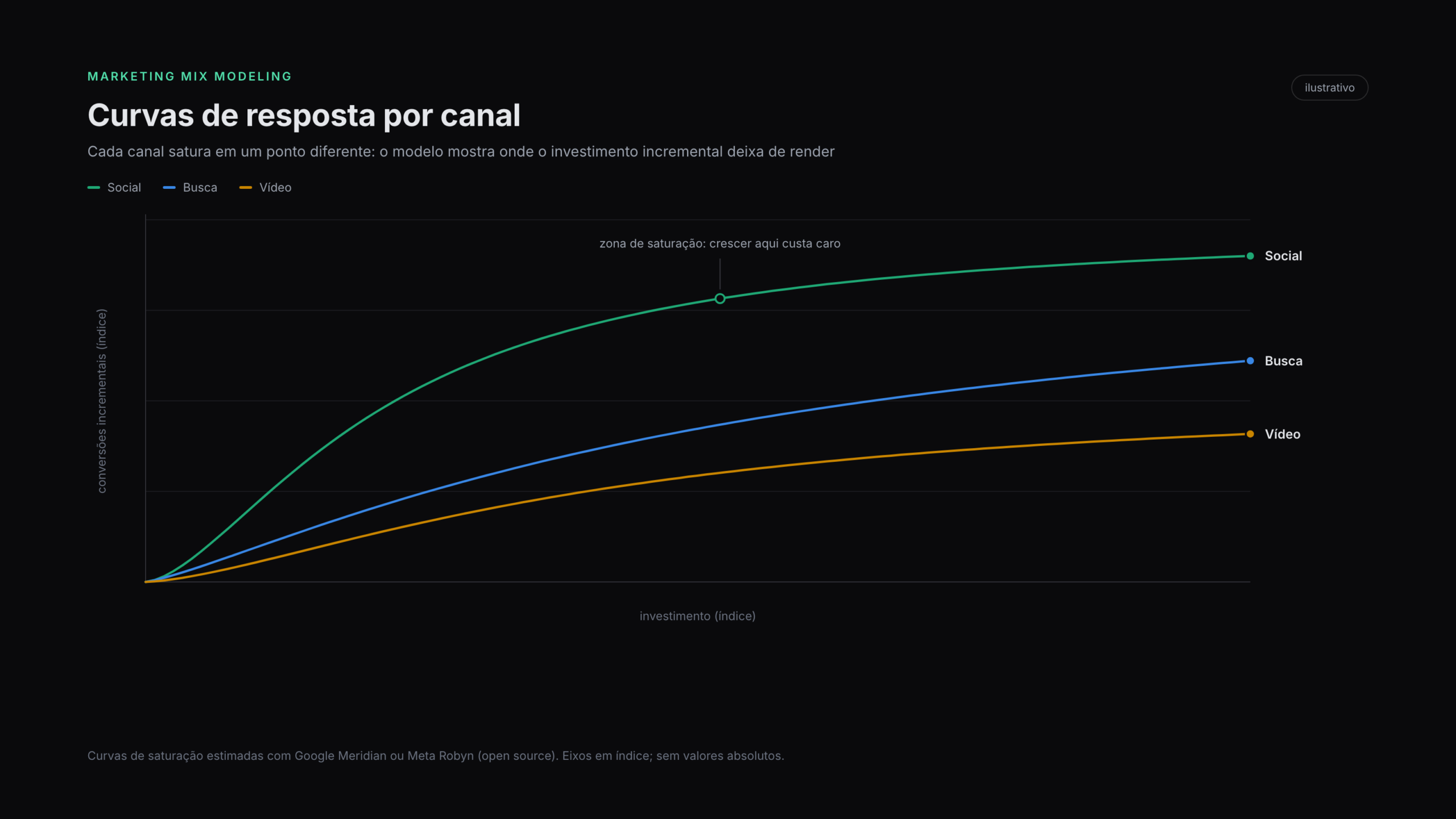
- ● Where does each channel saturate and start burning budget?
- ● What happens to results if a channel is cut by 20%? And if it doubles?
- ● How much of your outcome would happen anyway, with zero media?
- ● Which mix maximizes return on the same total budget?
From raw data to a reallocation plan
- 1
01
Audit: 18 to 24 months of spend and outcome history, with an honest viability read.
- 2
02
Modeling in Google Meridian or Meta Robyn, with statistical validation and robustness checks.
- 3
03
Simulated reallocation scenarios: cuts, increases and the optimal mix for the same budget.
- 4
04
Quarterly recalibration: forecast versus actuals, model updated, plan adjusted.
Can your mix survive an audit?
Send over the channels you run and what you measure today. You'll get a viability read on MMM before committing to anything.
Talk to Max MFrequently asked questions
How long does an MMM project take? +
Four to eight weeks from kickoff to scenario presentation, depending on data quality. Quarterly recalibrations are much faster: the model already exists and is simply re-estimated on fresh data.
How much historical data do I need? +
Ideally 18 to 24 months of spend and outcomes at weekly granularity. With less than that, the initial audit tells you whether a model holds up or whether it's worth collecting a few more months first.
How does pricing work? +
Fixed-scope project: audit, modeling and scenarios, priced upfront before kickoff. Quarterly recalibration is an optional recurring package. No software license, no mandatory retainer, no percentage of media spend.
Who owns the model and the data? +
You do. Code, data, documentation and assumptions live in your environment. If you later want your data team to run it in-house, there is zero agency lock-in.
How do you work with teams in other time zones? +
Async-first: written updates, recorded walkthroughs and live calls scheduled in your time zone. Deliverables in English, Portuguese or Spanish.